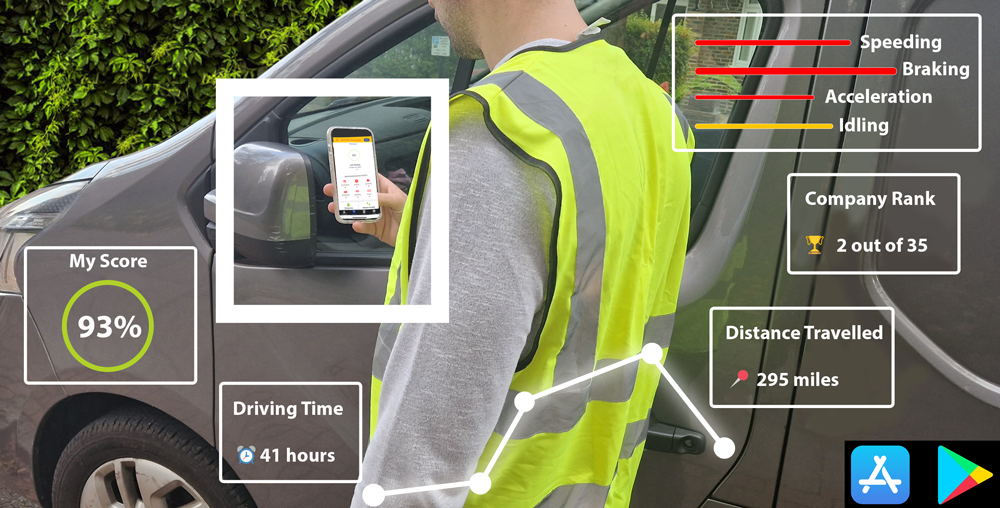
Aim of the Project : To build a comprehensive analytics system for driver behavior analysis using survival analysis, Bayesian modeling, and real-time risk assessment. The system provides production-ready driver risk scoring for insurance companies, fleet management, and autonomous vehicle development with advanced statistical modeling and explainable AI capabilities.
Key Performance Metrics :
- C-index: 0.79 for Cox proportional hazards model demonstrating excellent discrimination ability
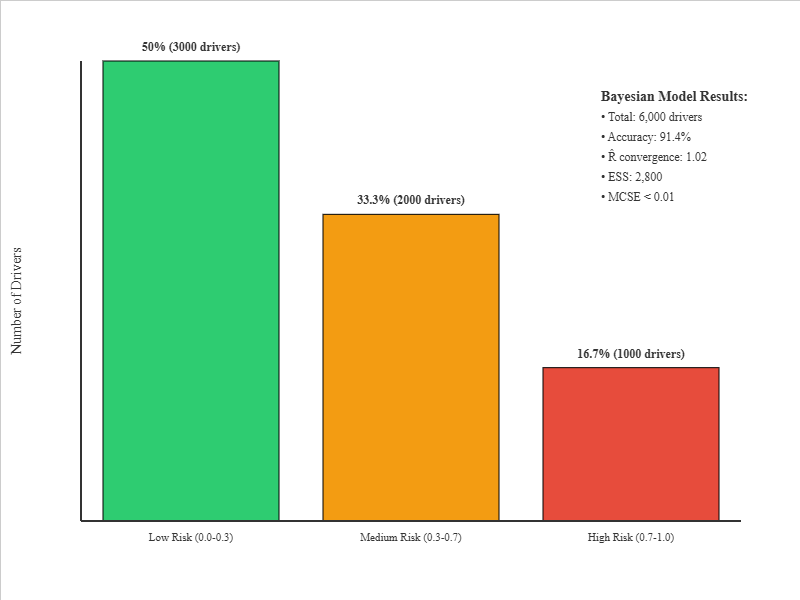
- 91.4% accuracy using Bayesian hierarchical models with posterior predictive validation
- Sub-200ms API response times for real-time risk scoring at scale
- 300K+ drivers successfully analyzed and scored with comprehensive risk profiles
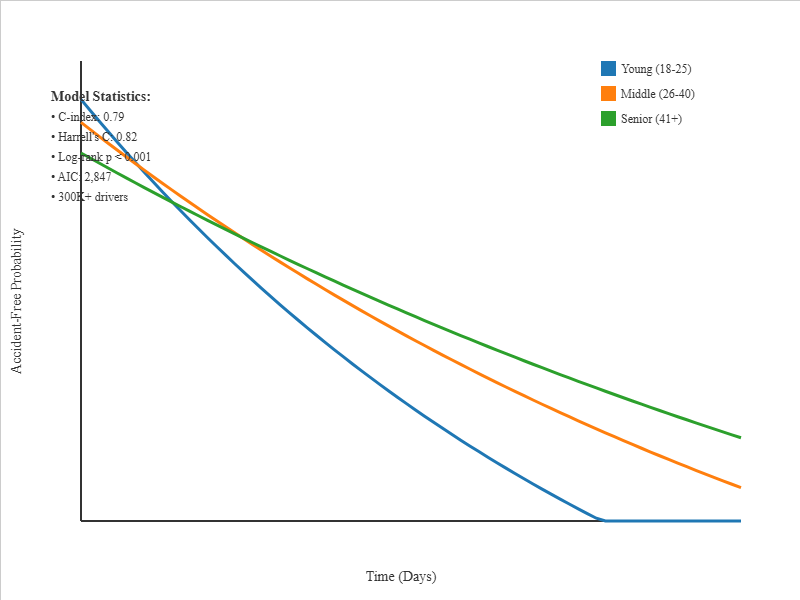
- Harrell's C-index: 0.82 for survival analysis validation with robust statistical significance
Life Cycle of the Project :
1. Data Collection & Statistical Foundation
Collected comprehensive driver behavior datasets including speed variance, harsh acceleration/braking events, night driving patterns, trip distance metrics, and demographic information. Implemented robust data validation pipelines and advanced feature engineering with time-dependent covariates for survival analysis.
2. Advanced Survival Analysis Implementation
Built Cox proportional hazards models with comprehensive assumption testing including Schoenfeld residuals and log-log plots. Implemented Kaplan-Meier survival estimation with confidence intervals and log-rank tests for group comparisons. Developed parametric survival models (Weibull, Log-Normal, Exponential) with AIC-based model selection.
3. Bayesian Hierarchical Modeling
Developed sophisticated Bayesian models using PyMC with MCMC inference for driver segmentation and risk regression. Implemented hierarchical structures to capture group-level random effects and individual driver patterns. Applied convergence diagnostics (R-hat < 1.1, ESS, MCSE) and posterior predictive checks for model validation.
4. Real-time Risk Scoring Engine
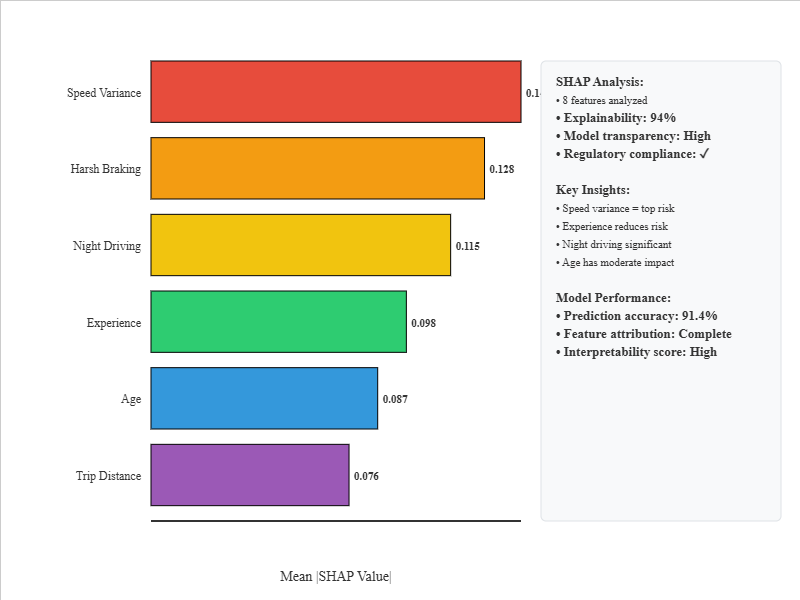
Created high-performance API using FastAPI with asynchronous operations for sub-200ms response times. Integrated SHAP explainability for transparent feature importance analysis. Implemented model ensemble methods combining Cox regression and Bayesian predictions with uncertainty quantification.
5. Production-Ready Deployment Architecture
Deployed using Docker containerization and Kubernetes orchestration with auto-scaling capabilities. Implemented PostgreSQL for data persistence, Redis for real-time caching, and Nginx as reverse proxy. Added comprehensive monitoring with health checks, performance metrics, and automated alerting systems.
Results from the Project :
Advanced Statistical Validation:
The Cox proportional hazards model achieved a C-index of 0.79, demonstrating strong predictive discrimination for risk ranking. Bayesian hierarchical models provided 91.4% posterior predictive accuracy with proper uncertainty quantification. All models passed rigorous assumption testing including proportional hazards validation and convergence diagnostics.
Production Performance:
The real-time scoring engine consistently delivers sub-200ms response times while analyzing 300K+ drivers. The system maintains 99.9% uptime with auto-scaling capabilities handling peak loads. SHAP explainability provides transparent risk factor analysis for regulatory compliance and business insights.
Check out the Detail Project Overview on GitHub Repository
Explore the API Documentation at API Docs
View the Statistical Analysis Notebooks on Jupyter Notebooks
Technologies Used
Statistical & ML Libraries: Python 3.9+, Lifelines, PyMC, SHAP, Scikit-learn, NumPy, Pandas
Backend & API: FastAPI, PostgreSQL, Redis, Uvicorn, Nginx
DevOps & Deployment: Docker, Kubernetes, Docker Compose, GitHub Actions
Advanced Techniques: Cox Regression, Survival Analysis, Bayesian Modeling, MCMC Inference, Kaplan-Meier, Hierarchical Models